
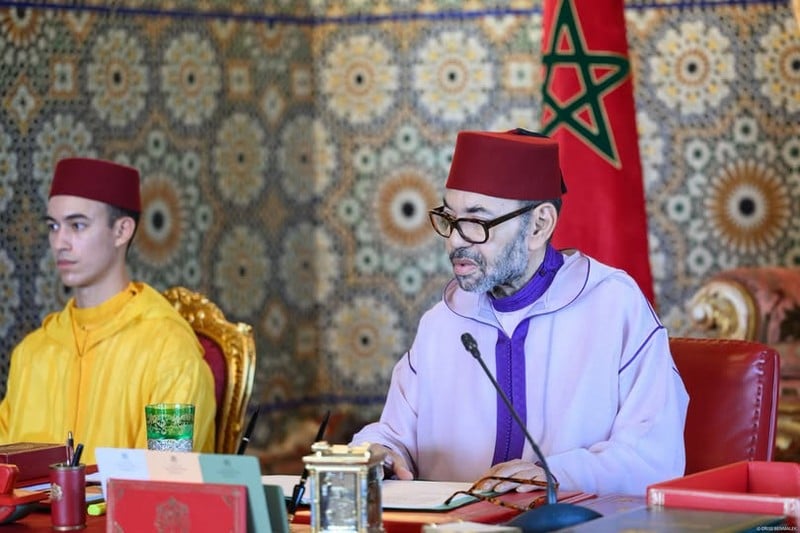
HM the King Chairs Council of Ministers
Rabat – His Majesty King Mohammed VI, may God assist Him, accompanied by His Royal Highness Crown Prince Moulay El Hassan, chaired Saturday at the Royal Palace in Rabat a Council of ministers, according to a statement by the Royal Office.
Here follows the translation :
“His Majesty King Mohammed VI, may God assist Him, accompanied by His Royal Highness Crown Prince Moulay El Hassan, chaired a Council of ministers on Saturday, October 17, 2026, corresponding to Jumada I 5, 1448 AH, at the Royal Palace in Rabat, to examine and adopt the general guidelines of the Draft Finance Bill for the year 2027.
At the onset of the Council’s proceedings, and in accordance with the provisions of Article 49 of the Constitution, the Minister of Economy, Finance, and Public Performance presented to His Majesty the King an overview of the main points of the Draft Finance Bill for the year 2027.
The Minister emphasized that this Bill comes amid a highly volatile international environment, marked by the rising cost of geostrategic conflicts, growing protectionist trends, and intensifying competition over energy, technology, and financing.
In the face of these changes, our country continues, under the enlightened Leadership of His Majesty the King, may God preserve Him, to consolidate the foundations of its resilience and strengthen the dynamism of its economy. As a result, the national economy is projected to grow by 4.7% by the end of the current year, with inflation contained at 0.7%, alongside a reduction in the budget deficit, which is expected to be lowered to 3% of GDP.
The Draft Finance Bill for fiscal year 2027 is structured around the following five priorities:
First: Restoring purchasing power and reinforcing the foundations of a sustainable social State: In this context, a structural reform of markets and prices will be launched beginning in 2027, with measures to support citizens’ purchasing power, continue the expansion of health coverage, while ensuring the sustainability of these systems, increasing direct social assistance, upgrading public health and education systems, and improving access to decent housing through the implementation of the direct housing assistance program.
Second: Integrating youth into education, training, and decent employment: The government will work to launch an integrated national program for youth for 2027-2031, guiding them toward a set of programs focused on training, business incubation, and facilitating access to funding, guarantee mechanisms, and markets.
Third: Accelerating the implementation of advanced regionalization and the new generation of integrated territorial development programs: in accordance with the High Royal Guidelines relating to the reallocation of powers at the regional level, based on an approach focused on clarity and efficiency, as well as on strengthening coordination and contractual mechanisms between the State and the regions, alongside the full implementation of the National Charter on Administrative Decentralization.
Fourth: Bolstering strategic water, energy, food, and digital sovereignty: to ensure strategic water security, accelerate the renewable energy development program, and continue the rollout of Morocco’s green hydrogen initiative, as well as the gradual implementation of the natural gas infrastructure roadmap, alongside a series of measures to guarantee food security and strengthen national digital sovereignty.
Fifth: Building a strong economy capable of funding social and sovereign ambitions, while accelerating the implementation of institutional reforms and preserving macroeconomic and fiscal balances: with a view to mobilize the necessary funding to expedite ongoing projects, advance major development initiatives and implement sectoral strategies across various fields, while fostering new sovereign industrial ecosystems.
The Draft Finance Bill for the year 2027 also pays particular attention to bolstering private investment by enshrining the support mechanisms provided for in the Investment Charter and continuing the reform of the Regional Investment Centers, while emphasizing support for micro, small, and medium-sized enterprises.
The Draft Finance Bill for the year 2027 further places particular emphasis on youth, one of the most significant and urgent challenges of this phase. This calls for moving beyond the multiple fragmented sectoral programs, whose shortcomings have become apparent, towards an integrated national policy to monitor young people’s pathways, from education and training through to employment and housing, thus guaranteeing them economic and social stability.
And in accordance with the High Royal Guidelines, efforts will be made to accelerate the implementation of the new generation of integrated territorial development programs by allocating approximately 25 billion dirhams in budgetary appropriations.”