
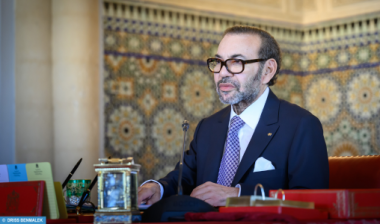
HM the King Delivers Address to Participants of 8th World Congress of United Cities & Local Governments (Full Text)
Tangier – His Majesty King Mohammed VI, may God assist Him, delivered an Address to participants in the 8th World Congress of United Cities and Local Governments (UCLG), held under the High Patronage of His Majesty the King from June 22 to 25 in Tangier, under the theme “New Generation of Universal Local Public Services.”
Here follows the full text of the Royal Address, read out on Tuesday by Minister of the Interior Abdelouafi Laftit, during the official opening ceremony of this Congress.
“Praise be to God.
May peace and blessings be upon the Prophet, His Kith and Kin.
Your Excellencies,
Ladies and Gentlemen,
As the Eighth World Congress of the United Cities and Local Governments convenes in Tangier, under my high patronage, it gives me great pleasure to welcome all participating local and regional leaders, government officials, elected representatives, experts, and representatives of international organizations and networks.
I am delighted that the Kingdom of Morocco is hosting this prestigious international forum, which addresses issues that are key to the future of development and governance worldwide, particularly the promotion of democracy and local governance, and the consolidation of spatial justice and of the pivotal role that cities, regions, and local authorities should play to ensure a more equitable, sustainable future.
That Tangier is hosting this conference carries profound significance. A symbol of cultural openness and a city strategically located at the crossroads of continents and seas, Tangier embodies the spirit of interaction and convergence between peoples and cultures. It reflects the image of Morocco as a nation which is open to its surroundings, which has faith in its policy choices, which is committed to its identity, and which looks confidently to the future.
Your choice of theme – “New Generation of Universal Local Public Services” – reflects a collective awareness that territorial governance is no longer merely an administrative or organizational matter. It has become a fundamental lever for promoting spatial justice, reducing social disparities, renewing trust between citizens and institutions, and turning major international commitments into tangible projects in cities, regions, and local constituencies.
Your Excellencies,
Ladies and Gentlemen,
Since ascending the throne of my venerable ancestors, I have sought to make territorial reform one of the strategic pillars of the nation’s social project and development process. This is because I firmly believe that a modern state is not gauged solely by the strength of its central institutions, but also by its ability to empower its local authorities to take the initiative, to participate, to bring public decision-making closer to the citizen, and to ensure that territorial development is the product of integration and concerted efforts between the state, local authorities, and other stakeholders.
The advanced regionalization, whose foundations I have laid down in Morocco, is a strategic choice for modernizing the state, consolidating local democracy, releasing energies, consecrating the principle of equity among regions, and making sure the development process is tailored to the specific characteristics, capabilities, and needs of each region and its inhabitants.
This vision has made it possible to enhance the region’s standing as a platform for strategic planning, for mobilizing investment, and for stimulating local economic activity and strengthening the convergence between sectoral and territorial programs. It has also strengthened the role of prefectures, provinces, and communes as part of an institutional approach based on free enterprise, solidarity, cooperation, and accountability.
Our goal is to establish a creative territorial system that does not stop at managing daily needs, but rather one that is capable of anticipating change, properly channeling investment, keeping pace with the digital and environmental transition, improving the quality of public services, and integrating youth, women, and vulnerable groups into the development dynamic.
The Moroccan experience in the area of decentralization and advanced regionalization derives its strength from being a part of a more comprehensive vision of integrated territorial development. I perceive territories as spaces for releasing energies, mobilizing resources, building partnerships, and making sure local initiatives are in sync with national programs.
With that approach in mind, I have launched a new generation of integrated territorial development programs that reflect a firm desire to revisit work methods in the public sphere. We started by launching a precise diagnosis of the needs of the population, listening to local actors, and setting priorities in light of the direct impacts on the citizen, especially in the areas of employment, education, health, water, territorial rehabilitation, and improved conditions for a dignified life.
These programs are important not just because of the size of the projects involved, but also because of the underpinning methodology, which is grounded in consultation, contracting, monitoring, evaluation, efficient use of resources, and a focus on making sure results match the goals sought. Territorial development thus becomes a common aspiration – one in which the state, local governments, the private sector and civil society shoulder a common responsibility, which is to formulate projects, implement them, and assess their impact.
Ladies and gentlemen,
Your conference is being held at a delicate time, as the world faces the increasing effects of climate change, demographic pressures, migration issues, widening social and spatial disparities and a growing demand for closer, better quality, more efficient, and more equitable public services. These challenges are showing, day after day, that the future is not built only by central decisions, but also through the involvement of the territories and regions where public policies are implemented, bearing in mind the economic, social and environmental repercussions they have on such areas as education, health, housing, water, environment, transportation, culture, entertainment, and job creation.
The theme of your conference is consistent, in essence, with what we seek to achieve in the Kingdom of Morocco – namely to make sure territorial public policies serve the citizen, and to show that access to basic services is a citizen’s right, not a privilege determined by a person’s place of residence or social status.
It follows, therefore, that the discussion on the future of inclusive local public services, the new local social contract, territorial development financing, digital transformation, climate justice, and territorial diplomacy is particularly important because it calls for building a new relationship between governments, local communities, and citizens. This relationship is to be based on proximity, listening, consultation, transparency, participation, and care, reflecting a common public responsibility to achieve equitable, sustainable development.
Your “100 Days of Local Multilateralism” initiative makes your congress a milestone in an integrated international process. It reflects a growing conviction that local and regional governments are no longer mere instruments for implementing international commitments, but rather full-fledged partners in shaping them, and a driving force for change within the global governance system.
Ladies and Gentlemen,
The development dynamic in the Kingdom of Morocco is a reflection of our country’s immutable values. The latter are at the heart of our national consensus and of our country’s stability and development.
In this regard, major development projects continue to be implemented in our southern provinces in the Moroccan Sahara. They are turning these provinces into areas for growth and stability, making them a hub for the consolidation of African and Atlantic cooperation, based on a comprehensive vision rooted in solidarity, regional integration, and joint development.
In the same vein, the initiatives I have launched for the benefit of the African continent are part of an innovative vision of South-South cooperation. They include the initiative to enable Sahel countries to access the Atlantic Ocean, the African-Atlantic Gas Pipeline Project, and the African-Atlantic States Initiative. These initiatives are turning the continent’s Atlantic coast into a strategic space for cooperation and shared prosperity. They also reinforce Morocco’s role as a reliable actor and a committed partner for the achievement of integrated development in a stable Africa.
Morocco continues to leverage decentralized international cooperation as a practical instrument for sharing experiences and expertise among local authorities, particularly with African counterparts. This is done through the African support fund for international decentralized cooperation of local authorities. Since its establishment in 2020, the Fund has become an innovative mechanism for supporting impactful local partnerships and consolidating African cooperation based on local development, good governance, capacity building, and the exchange of expertise.
Your Excellencies,
Ladies and Gentlemen,
The success of local governance is contingent upon the ability of elected institutions to play their part in full. It also hinges on the competence of elected officials, on strengthening consultation mechanisms, and on building partnerships across all levels of public administration.
I therefore urge you to ponder the ways and means for the development of a new generation of territorial governance mechanisms based on proximity, equity, sustainability and efficiency – one that empowers local and regional governments and gives them the necessary means to carry out their mission, be it in terms of funding, capacity building, digital transformation, or partnership with international institutions, development banks, the private sector, and civil society.
I look forward to practical recommendations that strengthen the role of cities, regions, and local communes in tackling common challenges, and that open up new prospects for more inclusive, more accessible public services that preserve the citizens’ dignity and fulfil their legitimate aspirations.
Before concluding, I pray that Almighty God grant you success and guide your steps so that the proceedings of your Congress may serve as a new building block in promoting more equitable, inclusive, and sustainable territorial governance.
Thank you.
Wassalamu alaikum warahmatullah wabarakatuh.”