
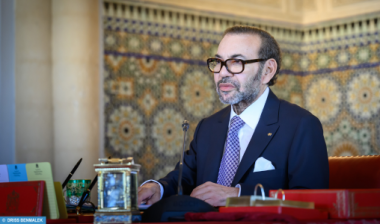
Under His Majesty the King’s Enlightened Leadership, Morocco Turned Peace, Security, Stability in Africa into Strategic Choice, Continued Commitment

Luanda – Morocco, under the enlightened leadership of His Majesty King Mohammed VI, has turned peace, security, and stability in Africa into a strategic choice and a continued commitment through its contributions to conflict prevention, mediation, maintaining and strengthening peace, and post-conflict reconstruction, said the Head of Government, Aziz Akhannouch, on Sunday in Luanda.
Akhannouch, who is representing His Majesty the King at the African Union’s extraordinary session dedicated to strengthening the mechanisms of conflict prevention and resolution in Africa, held in the Angolan capital, was accompanied by the Minister of Foreign Affairs, African Cooperation and Moroccan Expatriates, Nasser Bourita, the Kingdom’s Ambassador and Permanent Representative to the African Union and the United Nations Economic Commission for Africa, Mohamed Arrouchi, and Morocco’s Ambassador to Angola, Saadia Alaoui.
The Head of Government explained that the Royal Vision is based on the deep conviction that peace, security, and development are interdependent and indivisible dimensions, noting that lasting conflict prevention must necessarily involve addressing their root causes, mainly economic, social, institutional, climatic, and humanitarian.
He underlined that peace is not only built through interventions after the outbreak of crises, but also by investing in factors that promote lasting stability, mainly by meeting youth’s aspirations, bolstering the role of women, and creating job opportunities, as well as strengthening food, water, and energy security, developing infrastructure and connectivity on a continental scale, and promoting economic integration.
After noting that these are not mere development policies, but rather genuine pillars that directly contribute to strengthening peace and stability, Akhannouch maintained that “we must progressively go from a conflict management approach to one that builds the conditions for peace and prevents conflicts before their outbreak.”
In this respect, he recalled that His Majesty King Mohammed VI grants particular importance to efficient, solidarity-based, and concrete South-South cooperation, placing the African citizen at the center of its priorities and translating African solidarity into concrete projects in the fields of food, water, energy, health, training, investment, and infrastructure.
He added that strengthening peace and stability also requires tackling emerging and growing challenges, such as climate change and water stress, terrorism and transnational organized crime, as well as the spread of non-state armed groups, which represent a threat to state authority, sovereignty, and territorial integrity. Akhannouch also noted outside interference and the risks of disinformation resulting from the misuse of modern technologies.
The Head of Government pointed out that Africa’s responsibility with regard to its security, stability, and future also requires boosting its capacity to count on its own means and resources.
He concluded that Africa needs solid and balanced international partnerships, but at the same time, must bolster its capacity to finance its own priorities and ensure their sustainability, whether they are plans aiming to strengthen peace, security, and stability, or sustainable development projects, which requires embedding the principle of Africa’s self-reliance.