
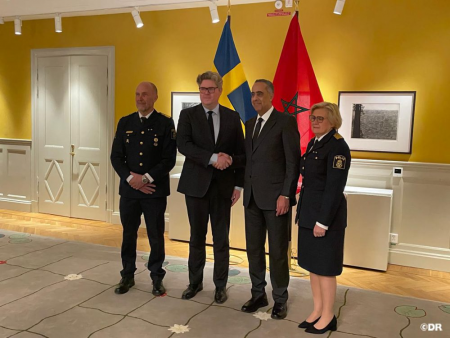
Morocco’s Top Police Chief in Sweden for Working Trip
Rabat – The Director General of National Security and Territorial Surveillance, Abdellatif Hammouchi, carried out a working visit to Sweden on April 20-21, heading a high-level security delegation composed of senior officials.
This visit comes within the framework of the Swedish security services’ will to strengthen relations of cooperation and coordination with their Moroccan counterparts, as well as a shared effort to reinforce their security partnership to encompass various areas of operational cooperation, exchange of expertise, and mutual technical assistance in the security field, according to a statement from the DGSN-DGST hub. On this occasion, Hammouchi held a series of talks with several Swedish officials, notably Minister of Justice Gunnar Strömmer, Swedish National Police Commissioner Petra Lundh, and Deputy National Police Commissioner Stefan Hector, the same source added. These discussions focused on a number of issues of common interest related to the security of both countries, as well as on coordinating efforts and the necessary mechanisms to address them through a joint approach, in addition to reviewing various security threats and emerging risks at the regional and international levels. At the conclusion of these talks, and as part of the two sides’ determination to elevate bilateral security cooperation to the level of a sustainable partnership, a memorandum of understanding was signed between the DGSN-DGST hub and the Swedish National Police. This memorandum aims to establish a contractual framework to strengthen mechanisms for exchanging expertise, experience, and best practices in policing, to consolidate joint security training, and to set out procedures for responding to information requests related to bilateral cooperation, the statement notes. It also defines clear and rapid procedures for the exchange of information between the police and security services of both countries, particularly regarding cases related to terrorism, extremism, and organized crime, especially drug and psychotropic trafficking, cybercrime and hacking, economic and financial crime, illegal immigration, human trafficking, and violent crime. In this context, the Swedish side proposed the accession of Moroccan security services to the European Network of Fugitive Active Search Teams (ENFAST) system, given the important role played by Moroccan services in locating and arresting internationally wanted individuals in cross-border crime cases. On the same occasion, the importance of drawing inspiration from the Moroccan security model and further expanding police cooperation with Morocco, as an “important and reliable partner,” was emphasized. The visit was also marked by bilateral talks with officials from Swedish intelligence and internal security services, notably Charlotte von Essen, Director General of the Swedish Security Service, focusing on security challenges related to the activities of terrorist groups in several regions of the world, particularly the Sahel-Saharan region, the Middle East, and Europe. These discussions also addressed “virtual operations” in the fight against terrorism and organized crime, especially in their cyber and cross-border dimensions. In the same context, the Director General of National Security and Territorial Surveillance visited several departments and units of the Swedish security services, including central intervention units, canine units, and cybercrime units. According to the statement, this visit illustrates the importance of bilateral security cooperation between Morocco and Sweden as active partners in international efforts aimed at strengthening security and stability, and confirms the shared determination of both countries to continue enhancing security cooperation and intelligence coordination in the face of all threats to their security. This trip also reflects the commitment of the DGSN-DGST hub to opening up to security partners across the world, with the aim of strengthening collective security and supporting efforts to neutralize threats to regional and international security.